
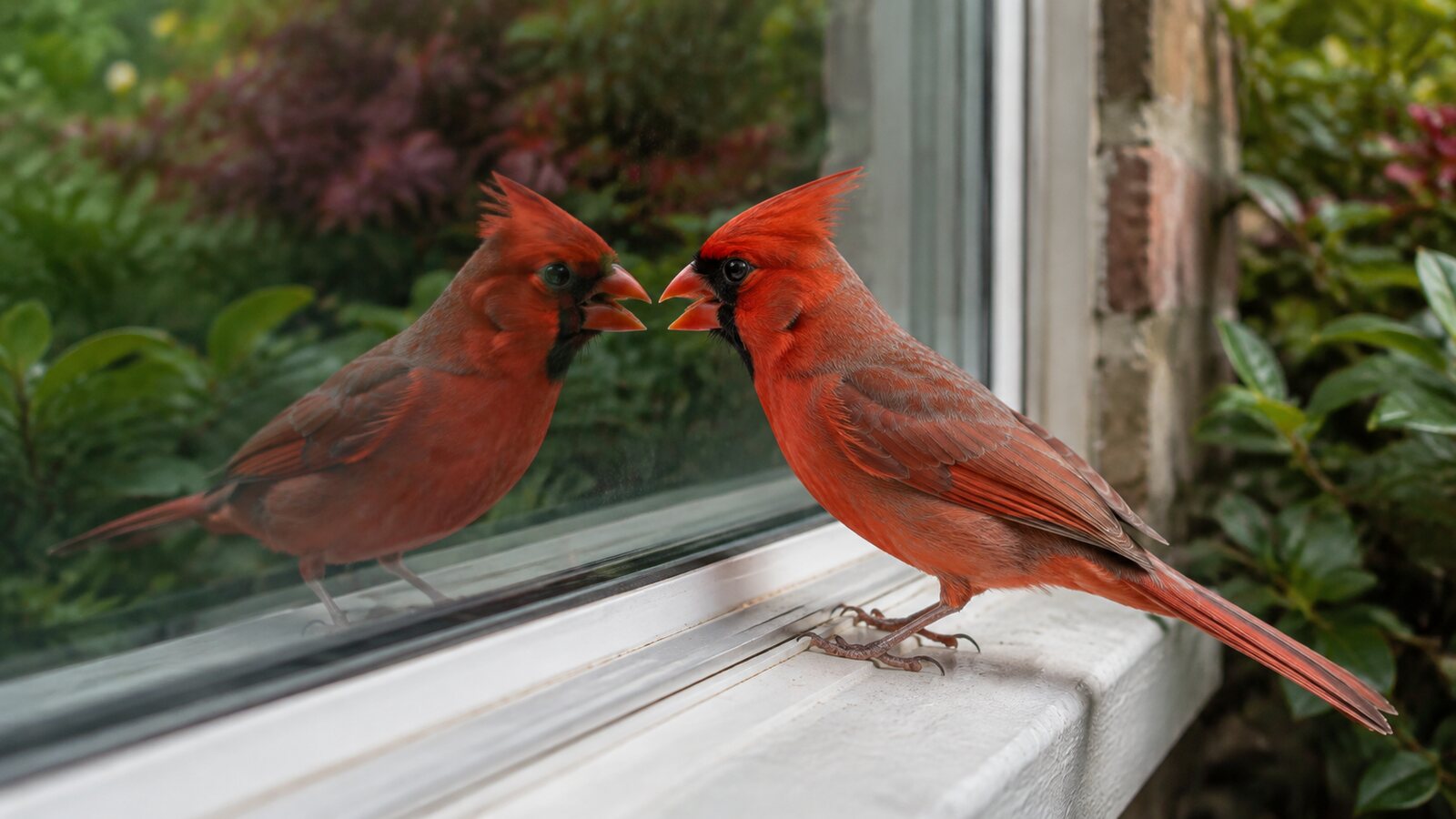
This is usually territorial behaviour
During breeding season, birds establish territories, seek mates, build nests, and raise young. A reflected bird can appear to be an intruder that refuses to leave.
The broader guide to why birds defend territories explains how song, posture, chases, and seasonal behavior normally keep rivals apart.
The real bird returns to confront the image, and the reflected “rival” returns every movement. This can create repeated pecking, wing-fluttering, calls, or short flights into the glass.
Spring and early summer are common times
Cornell reports that reflection attacks occur most often in spring and early summer, when territorial behaviour is strongest. The pattern may last several days or weeks and often fades as the breeding phase changes.
It can occur at other times too. Light, weather, vegetation, and the angle of a reflective surface may suddenly create a clear image that wasn’t visible before.
Both male and female birds may do it
It’s easy to assume that only males defend territory, but females may also attack reflections. Northern Cardinals, American Robins, bluebirds, towhees, sparrows, and other birds that live close to houses are commonly reported.
The species matters less than the pattern: a bird repeatedly focuses on the same reflective spot and appears to challenge the image.
Reflection attacks differ from accidental collisions
A territorial bird usually returns repeatedly, faces the glass, pecks, hovers, or flutters against one section. The behaviour may continue for minutes at a time and repeat each day.
An accidental collision is more likely to be one sudden flight into glass that reflects habitat or appears transparent. A collision victim may be found quiet or injured below the window and should be handled using the guidance in what to do after a bird hits a window.
Cover the outside of the reflection
The most direct solution is to alter what the bird sees. Cornell recommends changing the outside of the window because interior curtains may leave the exterior reflection intact.
Cover the exact area the bird attacks and enough surrounding glass that it can’t shift to a nearby reflected spot.
Temporary fabric or paper can work
Attach lightweight fabric, paper, or another opaque temporary covering to the outside of the problem area when it can be installed safely. Secure it so wind doesn’t create loose material that could tangle wildlife or damage the building.
Don’t lean out of an unsafe window or climb without suitable equipment. For upper floors or inaccessible glass, use a safely installed exterior shade, screen, or seek appropriate building assistance.
Soap or temporary markings can break up the image
Visible soap streaks, washable tempera paint, tape, or exterior markers can disrupt a reflection. Cover the broad problem area rather than making one small mark at the point where the bill touches.
If the glass also poses a collision risk, use the permanent spacing guidance in how to stop birds from hitting windows: treat the full exterior surface with gaps no larger than about two inches.
Exterior screens can solve both problems
A full exterior screen reduces reflections and makes glass more visible. It may also soften an impact if a bird flies toward the window.
The screen should cover the whole relevant area and remain securely fitted. Loose netting can create an entanglement hazard and shouldn’t be improvised around birds.
Closing blinds may not be enough
Interior blinds or curtains can reduce a transparent view through the building, but outside light may still turn the glass into a mirror.
Stand where the bird approaches and look at the window from outside. When you can still see a clear reflection of sky, shrubs, or yourself, the bird may still see its rival.
Cover car mirrors while parked
A side mirror can show a strong bird-sized reflection at exactly the height a territorial bird uses. Fold the mirror inward when the vehicle allows it or cover the mirror securely while parked.
Remove every cover before driving. Also check shiny bumpers, chrome trim, tinted windows, and nearby vehicles when the bird continues after one mirror is hidden.
Patio doors and glass railings can trigger attacks
A bird may target a lower corner of a patio door, a dark pane beside a shrub, or a glass railing that reflects a favourite perch. Treat the actual reflection rather than assuming the centre of the largest window is the problem.
Condominium or rental rules may affect exterior coverings. Ask for permission for a temporary removable treatment and explain that it protects wildlife and the glass from repeated impacts.
Don’t use harmful deterrents
Don’t use glue, sticky gels, oils, grease, sharp objects, traps, pesticides, or anything that could catch or injure the bird. The bird isn’t trying to damage the property on purpose.
A stationary plastic predator may work briefly, but birds can become accustomed to objects that never move. Removing the reflection is more dependable.
Reduce stress during the territorial period
Cover the reflection early in the day before the bird begins its routine. Keep pets away from the window and avoid repeatedly approaching the bird for photographs or video.
The bird needs time for feeding, nesting, and caring for young. Ending the false territorial challenge lets it return to those activities.
Keep the treatment in place long enough
Don’t remove a covering after one quiet hour. Wait until the bird has stopped checking the area for several days, then uncover a small portion and watch from a distance.
If the bird immediately returns, restore the treatment and try again later. Territorial timing varies by species and individual.
Use permanent window protection when needed
A reflection attack reveals that the window is visually confusing. Even after territorial behaviour ends, the glass may still reflect habitat and cause accidental collisions.
Consider a permanent exterior pattern, screen, cord system, or suitable film. The Version 9 prevention guide explains how to cover the full pane without leaving apparent flight gaps.
Check the bird for a true collision
Repeated pecking is usually lower-force territorial behaviour, but a bird can still strike hard or become exhausted. If it falls, remains on the ground, can’t fly normally, or seems injured, keep pets away and contact a licensed wildlife rehabilitator.
Don’t assume every bird near a reflective window is merely being territorial. Behaviour and condition determine which response is needed.
Collision or reflection behaviour?
| What you observe | Likely explanation and response |
|---|---|
| One sudden impact followed by a bird on the ground | Possible collision injury; keep pets away and call a wildlife rehabilitator. |
| Repeated pecking at the same spot | Territorial reflection; cover the outside reflection. |
| Hovering, calling, and returning daily | Territorial reflection; maintain the temporary exterior covering. |
| A bird attacking a car mirror while parked | Cover or fold the mirror, then remove the cover before driving. |
| A bird flies strongly into untreated reflected habitat | Collision risk; apply a permanent full exterior window treatment. |
| A repeated attacker falls or can’t fly normally | Treat it as an injured bird and contact a rehabilitator. |
How to stop the reflection
- Watch from a distance and confirm repeated territorial behaviour.
- Identify the exact exterior reflection.
- Cover or break up the full attacked area from outside.
- Check nearby panes, mirrors, chrome, and glass railings.
- Keep the treatment in place until visits stop for several days.
- Add permanent bird-safe window protection when the glass remains risky.
Frequently asked questions
Why is a bird attacking my window?
The bird usually sees its own reflection as a territorial rival. This behaviour is especially common during spring and early summer, and both male and female birds may do it.
How do I stop a bird from pecking at a window?
Break up the reflection on the outside of the glass. Fabric, paper, temporary exterior markings, screens, or another visible barrier can work.
Why is a bird attacking my car mirror?
The mirror reflects a bird-shaped rival. Fold the mirror inward when possible or cover it while the vehicle is parked, removing the cover before driving.
Will the bird stop attacking the reflection?
Territorial reflection behaviour often fades after days or weeks as the breeding phase changes. Keep the reflective surface covered while the behaviour continues to reduce stress and possible injury.
Sources and further reading
- Cornell Lab: territorial window and car-mirror behaviour
- Cornell Lab: reflection aggression and bird-safe treatments
- National Audubon Society: birds attacking reflections
Northern Cardinals are among the familiar species that can become very persistent around reflections. See the full Northern Cardinal guide for identification, song, food, and nesting.