
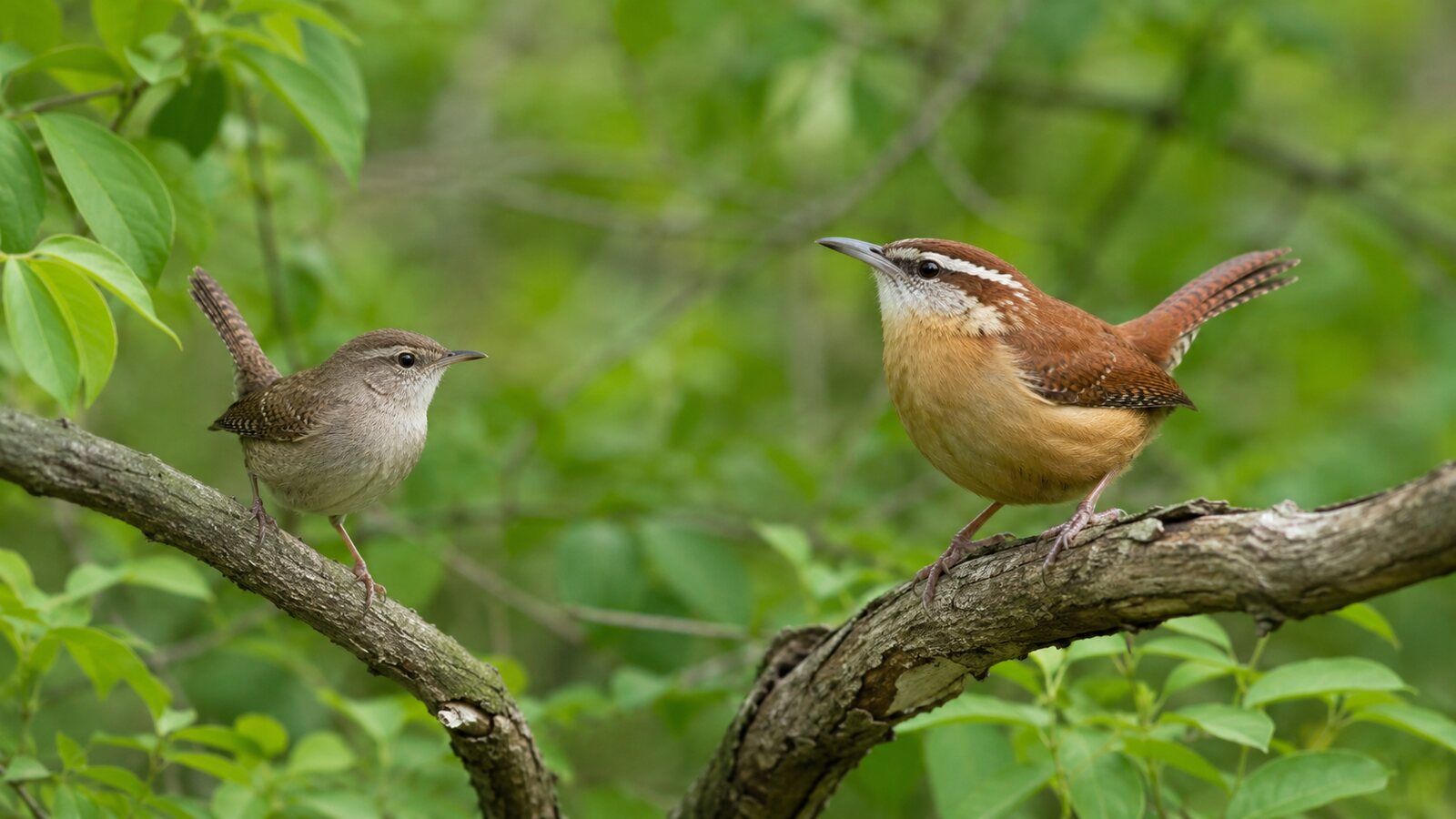
House Wren and Carolina Wren comparison
| Clue | House Wren | Carolina Wren |
|---|---|---|
| Size | Tiny and compact | Larger and heavier |
| Face | Plain, with a faint eyebrow | Bold white eyebrow and dark eye line |
| Upperparts | Plain gray-brown to warm brown | Rich reddish-brown |
| Underparts | Pale grayish or buff | White throat and warm buff belly |
| Bill | Shorter and finer | Longer and slightly downcurved |
| Song | Long, fast, bubbling jumble | Loud repeated three-part whistles |
| Range | Widespread breeder; many northern birds migrate | Mostly year-round in the East and Southeast |
| Backyard food | Mainly insects; rarely a feeder regular | Insects, plus occasional suet, peanuts, or sunflower chips |
The easiest way to tell them apart
Use three clues together: eyebrow, colour, and voice. A Carolina Wren usually shows a striking white eyebrow on a rich rusty-brown head and back. Its song is loud and often built from a short phrase repeated several times.
A House Wren looks much plainer. It is a small brown bird with fine barring on the wings and tail, and its song tumbles through a long series of trills, rattles, and bubbling notes.
Compare size and shape
Both birds have rounded bodies, slender bills, and tails that may point upward. Carolina Wrens are noticeably larger, with a fuller body, bigger head, longer bill, and longer tail. House Wrens look tiny and quick, especially beside a feeder, nest box, or familiar branch.
Distance can fool you, so size works best when the bird is near a known object. Posture is less dependable because either wren can raise or lower its tail.
Look at the eyebrow and body colour
The Carolina Wren's bold white eyebrow is visible from many angles. Its back, wings, and tail are warm reddish-brown, while the throat is white and the belly is buff.
A House Wren may show a pale line above the eye, but it is weak and rarely creates the crisp face pattern of a Carolina Wren. House Wrens vary from gray-brown to warmer brown, and lighting can change that impression. Fine bars on the wings and tail are useful supporting marks.
Listen before the bird disappears
A House Wren song is a long, energetic jumble. It may begin with dry notes and run into bubbling trills and rattles, often changing within the same performance.
A male Carolina Wren typically gives powerful, clear phrases repeated in a regular pattern. People sometimes render one version as tea-kettle, but individual songs vary. Pairs also make raspy chatter and scolding calls.
Record rhythm and repetition instead of relying on one written phrase. The guide to identifying birds by sound explains how pitch, pace, and phrase shape can confirm what you heard.
Use range and season as supporting clues
House Wrens breed widely across much of North America. Many leave northern breeding areas for winter, so a tiny plain wren in summer may be much more likely than in January.
Carolina Wrens are year-round residents across much of the eastern and southeastern United States. Their range has expanded northward, though severe winters can affect local numbers. The two species overlap broadly, so location narrows the choice but does not settle it.
Backyard behaviour and nesting
Both birds search low vegetation, brush piles, tree bark, and garden edges for insects and spiders. House Wrens often move rapidly through open shrubs and woodland edges. Carolina Wrens are strongly associated with dense tangles, vines, brush, and sheltered corners.
Both nest in cavities and may use nest boxes. Carolina Wrens also choose flowerpots, shelves, mailboxes, and other protected spaces around buildings. A nest location is a clue, not proof, because wrens can be flexible.
Carolina Wrens may visit suet feeders for suet or peanut pieces, especially in cold weather. House Wrens usually remain focused on live insects.
Male, female, and young wrens
Male and female House Wrens look alike. Male and female Carolina Wrens also look alike, so the bold eyebrow does not identify sex.
Young birds can look softer, duller, and less neatly marked. Use the whole combination of size, face, colour, voice, range, and behaviour rather than expecting a juvenile to match a perfect adult photograph.
Which wren did you probably see?
You probably saw a Carolina Wren if the bird was fairly large for a wren, richly reddish-brown, showed a bold white eyebrow, and delivered loud repeated whistles from dense cover.
You probably saw a House Wren if the bird was tiny and plain-faced, moved quickly around a cavity or nest box, and sang a long bubbling jumble. If the view was brief, leave the identification as “wren” until you hear or see another clue.
Frequently asked questions
What is the easiest difference?
The face. Carolina Wrens have a bold white eyebrow, while House Wrens have a much plainer face.
Do they sound alike?
Not usually. House Wrens give long, bubbling, changeable songs. Carolina Wrens often repeat loud, clear three-part phrases.
Do both use nest boxes?
Yes. Both are cavity nesters and may use a suitable nest box.
Can both occur in the same yard?
Yes, especially where their eastern ranges overlap and the yard has both open shrub edges and dense cover.
Full species guides
Continue with the full House Wren guide or Carolina Wren guide.