
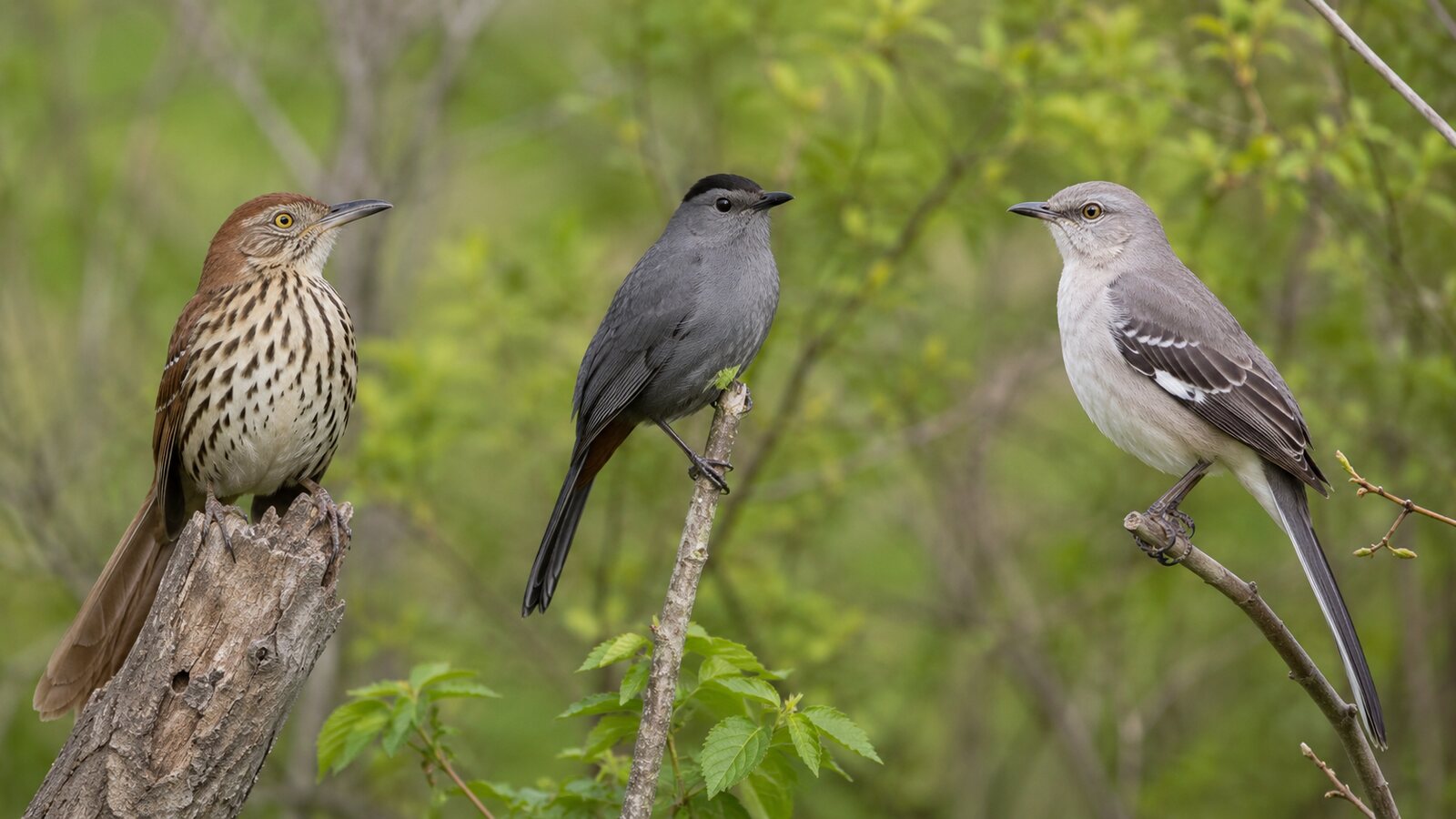
Thrasher, catbird, and mockingbird comparison
| Clue | Brown Thrasher | Gray Catbird | Northern Mockingbird |
|---|---|---|---|
| Colour | Rich rusty brown above | Dark slate gray | Pale gray above, whitish below |
| Underparts | Pale with heavy dark streaks | Mostly plain gray | Plain pale gray or white |
| Special marks | Yellow eye and two pale wing bars | Black cap and rusty undertail | White wing patches and outer tail |
| Bill | Long and slightly curved | Medium and fairly straight | Slender and slightly curved |
| Song pattern | Phrases often repeated twice | Irregular mixed stream | Phrases often repeated several times |
| Familiar call | Sharp smack or harsh notes | Nasal cat-like mew | Harsh checks and varied calls |
| Typical position | Ground and dense brush | Dense shrubs and tangles | Open lawns, edges, and exposed perches |
The easiest way to tell them apart
Look at the breast and wings. A Brown Thrasher has obvious dark streaks down a pale breast. A Northern Mockingbird has plain underparts and flashes broad white patches in the wings during flight. A Gray Catbird is darker and more evenly gray, without the mockingbird's large white wing patches.
If the singer remains hidden, listen to repetition. Brown Thrashers often use pairs, mockingbirds often repeat a phrase several times, and catbirds deliver a less orderly mixture.
Brown Thrasher field marks
Brown Thrashers are warm rusty brown across the back, wings, and long tail. Their pale underparts are covered with bold dark streaks. A bright yellow eye, long slightly curved bill, and two pale wing bars add useful detail.
They spend much of their time on or near the ground, sweeping leaves aside with strong sideways motions. Even when hidden, the noisy leaf tossing can reveal where to look.
Gray Catbird field marks
Gray Catbirds are smooth slate gray with a darker black cap. A rusty patch beneath the tail may show when the bird raises its tail or changes position. The bill and legs are dark, and the overall pattern is much plainer than a thrasher's.
Catbirds favour dense shrubs, vines, and thickets. They may sing from within cover, then slip between branches rather than remain on an exposed perch.
Northern Mockingbird field marks
Northern Mockingbirds are pale gray above and whitish below with long tails. Large white wing patches become striking when the wings open, and white outer tail feathers flash during flight or display.
Mockingbirds often use open habitats, lawns, parking areas, hedges, and exposed treetops. They may run on the ground, raise their wings in short displays, or defend fruit and territory vigorously.
Compare the songs by phrase pattern
A Brown Thrasher has a large repertoire and often repeats one phrase twice before changing to the next. The song can be rich and musical, with clear pauses between pairs.
A Northern Mockingbird also learns and combines many sounds, but it commonly repeats each phrase three or more times. It may sing for long stretches from a high open perch, sometimes at night in well-lit areas.
A Gray Catbird song is often quieter, rougher, and less organized into obvious repeated blocks. It can mix whistles, squeaks, rattles, and copied sounds in a wandering stream. Its namesake call is a nasal mew.
The guide to identifying birds by sound can help you record repetition, tone, habitat, and time of day before choosing a species.
Size, shape, and tail
All three are medium-sized songbirds with fairly long tails. Brown Thrashers are the largest and often appear long, horizontal, and strong-legged on the ground. Mockingbirds are slimmer and long-tailed. Catbirds are more compact and softly rounded.
Distance changes apparent size, so use a branch, fence, feeder, or nearby familiar bird as a reference. Tail length alone will not separate all three.
Range, season, and backyard habitat
All three occur widely in eastern North America, and their ranges overlap. Northern Mockingbirds are common year-round across much of the United States. Gray Catbirds and Brown Thrashers are migratory in many northern areas, though local winter patterns vary.
A yard with dense native shrubs, fruit, leaf litter, and tangled edges may attract any of them. Catbirds and mockingbirds may take fruit or jelly, while Brown Thrashers usually search the ground for insects and other food. None is primarily a seed-feeder bird.
Male, female, and young birds
Males and females look similar in all three species. Juveniles can appear softer, duller, or more loosely marked than adults. Young mockingbirds may show breast spotting that adults lack, which can cause confusion in a brief view.
Use the whole bird, including back colour, wing pattern, face, tail, voice, and behaviour. One unusual feather or poor photograph should not outweigh several stronger clues.
Which bird did you probably see?
Choose Brown Thrasher when you see a rusty bird with a heavily streaked breast, yellow eye, and long bill scratching in leaves. Choose Gray Catbird for a dark, plain gray bird with a black cap and cat-like mew in dense shrubs. Choose Northern Mockingbird for a pale gray long-tailed bird with white wing flashes and repeated song phrases on an open perch.
If only the song was heard, save a recording. These skilled singers can copy sounds, so phrase pattern, habitat, and visible features should agree.
Frequently asked questions
How can I tell a thrasher from a mockingbird?
Brown Thrashers are rusty and heavily streaked. Mockingbirds are gray and white, with large white wing patches.
How can I tell a catbird from a mockingbird?
Catbirds are darker gray with a black cap and rusty undertail. Mockingbirds are paler and flash white in the wings and tail.
Which bird repeats each phrase twice?
Brown Thrashers often repeat phrases twice. Mockingbirds commonly repeat them several times.
Which bird makes the cat-like mew?
The Gray Catbird.
Full species guides
Read the Brown Thrasher, Gray Catbird, and Northern Mockingbird guides.